Tuesday, 14 May 2013

Water features at Suria Helang Lui

I love water, I love being close to water, I love hearing the sound of water.  With the wonderful, clean, water source, I try to maximize what I can do with it, both from food production, household water use and aesthetic landscaping.  The beauty of it all is since the water is from a continuous flowing water source, the water needs to continuously flow out or my pipes will burst so I have no guilt feelings of using the water in all these ways.  When necessary, all the plants are also watered from this same water inflow hence continuing the no chemicals concept on the food production.  My suggestion to those of you who are looking for a place for a retreat, always check the water source options.
At the farm, the water is used for household use including as a drinking water source.  For years now, I have been drinking it direct.  I feel no guilt in taking long, cool showers as the water has to continue to flow out.

One of the main farm activities is to produce tasty fish and the water plays an important role.  The water continuously flow in and out of the ponds, keeping the ponds clean and providing good quality water for the fish to grow and breed.  The pond itself was created based on an old stream which still has a pretty shallow water table.  This also serves as a flood prevention pond as this area has been known to flood albeit not very often.
I spend a substantial amount of time at the farm and I have a home there, my getaway from the busy, hectic Kuala Lumpur, and it is less than an hour
away.  To this end, I like to add features that would further provide for a peaceful and relaxing environment.  It took a couple of years but I finally have my landscape fish pond by the front entrance of the house with a mini waterfall as the water outlet.  There is a lot of river stones all over the property which as we work the land, we have "collected" and this pond features the use of these stones.  The sound of the water flowing into the fish pond is relaxing to hear and makes the area as a great place to have my breakfast, a wonderful way to start the day. 
Another water landscape feature is planned and this one is by the patio of my bedroom.  InsyAllah, this will be ready this year as will the house.

Wednesday, 8 May 2013

Curry tree (Pokok Kari)

No curry dish is complete without the addition of the leaves from the curry tree (Botanical name : Murraya koenegii ).  This tree is very easy to take care of and the growth can be controlled by frequent pruning.  The pruning also encourages it to form branches hence you can shape this tree.  In the late afternoon, as I walk by it, I always get a whiff of curry.
This tree can grow in sunny to partial shade areas.  Until recently, I didn't realize that it could produce beautiful white flowers.  The more mature the leaf is, the stronger the flavor of "curry" it has.
Whilst it is most often used as a "spice" for curry dishes, the young shoots are also eaten raw as ulam. 
Some of the therapeutic benefits reported are :
  • Helps to relieve the pain caused by kidney stones. They also cleanse the urinary tract, preventing bacterial infections.
  • The leaf has tonic properties. It can be mixed with honey or buttermilk to create an herbal drink to strengthen the digestive system. It can also help treat dysentery and diarrhea.
  • It can be applied externally on the skin as treatment for minor skin infections and eruptions.
  • The juice of curry leaves can be used as treatment for eye disorders and to prevent cataracts.
  • The root and bark of the curry plant have medicinal properties. In traditional medicine, the leaves are ground into powder and used to treat diabetes.
  • The fruit of the curry plant is also edible. It can be used for the effective relief and treatment of poisonous stings and bites.
As this tree is easy to grow and produces lots of leaves, you only need to plant one tree in your garden and with it leaves and white flowers, can be a beautiful and edible addition to your landscape.

Tuesday, 12 March 2013

Eggplants - So many varieties

Before I became a farmer, I was vaguely aware of the a couple varieties of the eggplant.  Now, I find that there are so many varieties and called a few names - eggplant, brinjals, aubergine and guinea squash - and is from the plant family Solanaceae.  As with the varied names, there are also many sizes, shapes and colors.  This plant is a perennial but is often cultivated as an annual in locations which have a climate other than tropical.
This plant is propagated from seeds.The plant can grow quite tall but can be controlled by selective pruning to help shape it.  It produces small purple or white flowers with a yellow stamen.  A healthy plant can produce lots of flowers, beautiful to look at so you might want to consider this for your home garden, both as a landscape feature and food source.  At the farm, it is watered regularly and fornightly organic fertilizing and this seems to result in good quality and quantity of flowers and fruit.  I also water them at least once a week with water from the fish pond so that it can receive the various minerals and nutrients available from this water.  Be careful with terung pipit though as it does have sharp thorns on its branches and stems.

It is difficult to spot the difference between the leaves so I wait until the plant produces the fruit although I can distinguish a couple of the varieties.  The fruits produce can weigh the plant stems down so it is important to stake them to prevent the plant from toppling or the fruits from laying on the gound which can damage it.  At the farm, I use a 1" pvc pipe of at least 1m long and then I thread "rafia" string along the branches to provide support.  I find that by threading the string, it prevents damage being done to the branches and provides balanced support.

Some varieties taste better than others eaten raw.  Other ways for preparing it include using it in curries, baked either with olive oil or with a cheese topping, dipped in batter and fried, sauteed with a seasoning of your choice, stuffed with cheese, seafood, breadcrumb mixture or whatever you fancy - the options are limited to your culinary imagination.  A special quality of terung pipit is it is often used locally is as a condiment to reduce the bitterness of papaya shoots.

There are probably more varieties so I look forward to more discoveries....

Tuesday, 5 March 2013

SHL Red Tilapia Asam Pedas


My latest culinary adventure in the SHL Kitchen was to create my own version of the local dish Asam Pedas.  The aim was to use as many ingredients as possible from the farm.  The fish used is fresh red tilapia and with its firmly soft (is that an oxymoron? I guess most of you know what I mean) and ability to absorb flavors, I thought it would be a good fish to use for this dish.  Next I had some bottle gourd which I felt would also be a great vegetable to add to this dish as it can absorb the flavors of the Asam Pedas.  I also used vine-ripened tomatoes to have that slight sweet taste and a touch of sourness.The herbs used in this dish was also available at the farm so the journey began.  The ingredients used were:
  1. Cleaned red tilapia (300gm fish size to make serving much easier
  2. Tamarind juice - add more if you like it really sour and less it you just want to have a subtle taste
  3. Red chillies
  4. Bottle gourd
  5. Vine-ripened tomatoes
  6. Shrimp paste (belacan)
  7. Persicaria odorata or known in English as Vietnamese mint or in Malay as Daun Kesom 
  8. Lemon grass or serai
  9. Red onion
  10. Salt to taste
I do not like to use the blender and prefer to use a mortar and pestle (lesung batu) to create a paste of chillies, belacan and tomatoes.  I also use it to pound the lemon grass to be added.  I brown the sliced red onions in oil and add the chilli-tomato-belacan paste to it.  After a few minutes, allowing the flavors to blend nicely, I added the tamarind juice, lemon grass, daun kesom and additional water to create a gravy.  After it is brought to a boil, the pieces of bottle gourd is added.  When this has become soft and the gravy brought to a boil, the fish is added.  Once the fish is cooked, it is now ready to serve.  It is an easy and quick dish to prepare, all in all taking less than 30 minutes to prepare from cleaning the fish to serving.

SHL Smoked Red Tilapia

One of the things I enjoy is to experiment with ways if preparing whatever we produce.  I began producing smoked red tilapia in November 2012 - in small quantities first to have people try it out.  Based on the positive feedback, I began to make them quite regularly and sell it at the Sunday morning market in Sg. Penchala.  It is a popular item and finishes fast.  Many have asked how it is made so here's how I process it so maybe whoever is interested can try to make it too.
Starting with fresh red tilapia, preferably those bred in running water ponds (as it tastes tons better), clean off the scales and cut it open from the "back" so that is splits open and remains joined by the "tummy" side.  This will enable the fish to absorb more of the marinate and "dries" faster.  Rinse it well and at the farm, since we have clean, river water, the fish doesn't get touched by chemicals in our normal water although it may be present in small quantities.  Be sure that the fish is really fresh or the meat of the fish will become "mush".
Nest step is to prepare the marinate.  The ingredients are:
  1. Lemon grass (serai)
  2. Calamansi (limau kasturi)
  3. Coarse salt
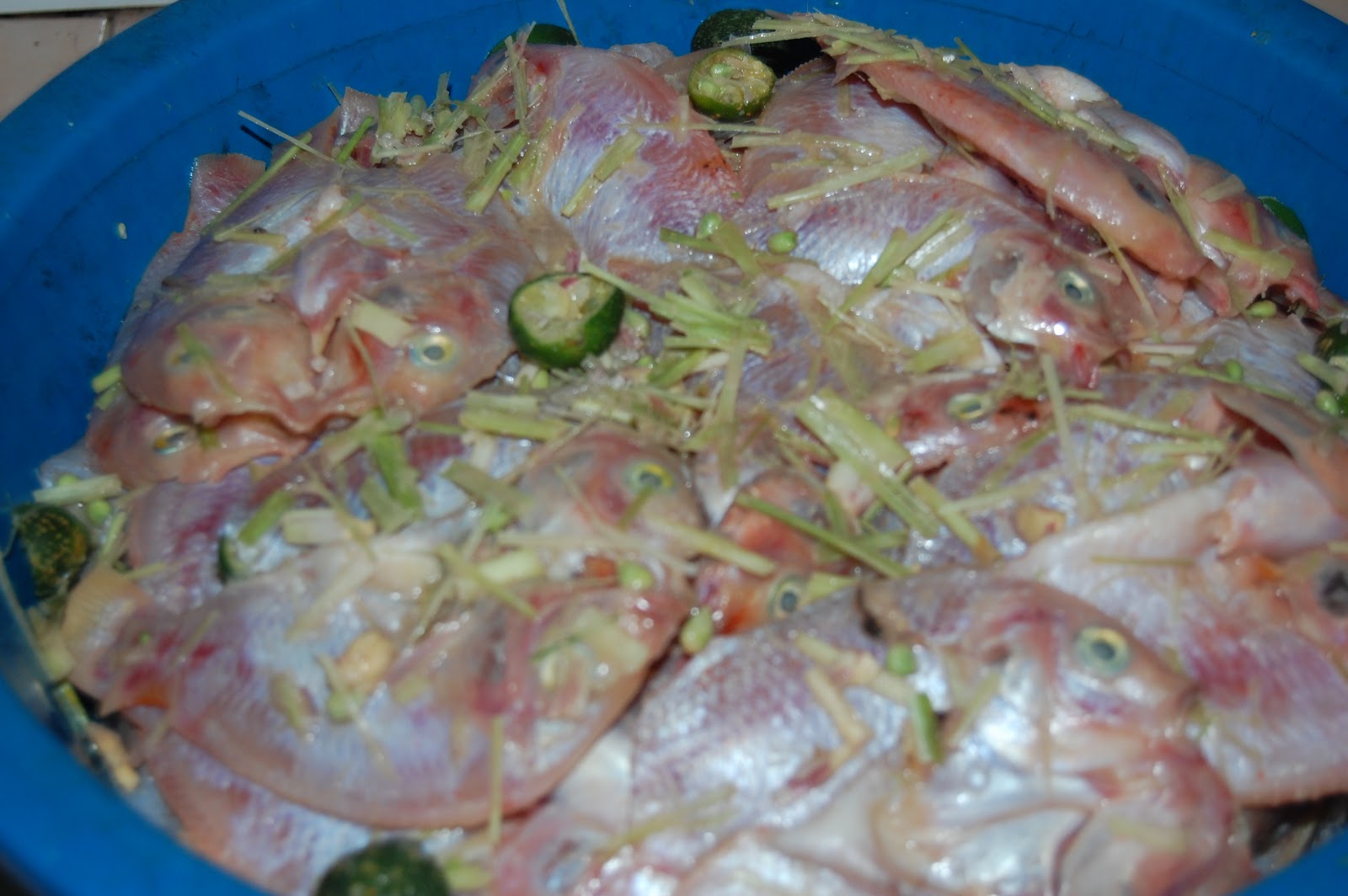
Pound the lemon grass and squeeze in the juice of the calamansi and add salt, mixing these ingredients well.  I also add the calamansi fruit that has been "juiced-out" in the marinate.  Add the fish and mix it well with the marinate and let it marinate for at least 6 hours, keeping it in the fridge the whole time.  I tend to marinate it for at least 24 hours.
The most time-consuming part is the smoking of these fishes.  It is important to have damp firewood that will create the smoke as well as turn into embers to provide the necessary heat to slowly dry the fish.  Be sure not to have flames as this will cook the fish too fast and not allow it to smoke nicely or you will end up with grilled fish and not smoked fish.
Now that you have the smoked fish, what do you do with eat.  There are many ways to prepare them for your meal:
  1. Fry them to create a crispy fish and you can munch on the whole fish.
  2. Cook a sambal with chillies and a touch of shrimp paste (belacan) and tamarind juice (air asam jawa) to create a spicy smoked red tilapia dish.
  3. Cook a coconut-based gravy either with or without chillies, with or without belimbing buloh and add the smoked fish to create a creamy dish or  masak lemak as an accompaniment to your rice.
  4. Chop it up and add to your rice porridge.
If any of you have any other ways of turning it into your meal, I would love to hear about it.  Happy trying :)

Wednesday, 13 February 2013

Marinated Red Tilapia

Starting with a great, fresh fish, there are many ways to prepare red tilapia.  Being very fortunate to have lots of ingredients that I can use as a marinate at the farm, I decided to experiment a bit to see how the flavors will blend.  I enjoyed it so I am sharing it here.  This marinate can be applied to 1-1.5kg of fish.  Ensuring that the fish is fresh and farmed in "running water" makes a difference to the final taste of the dish.

Ingredients for marinate:
  1. 2 stalks of lemon grass (serai)
  2. 1 yellow onion
  3. Fresh tumeric (kunyit)
  4. 3 calamansi (limau kasturi)
  5. Salt to taste
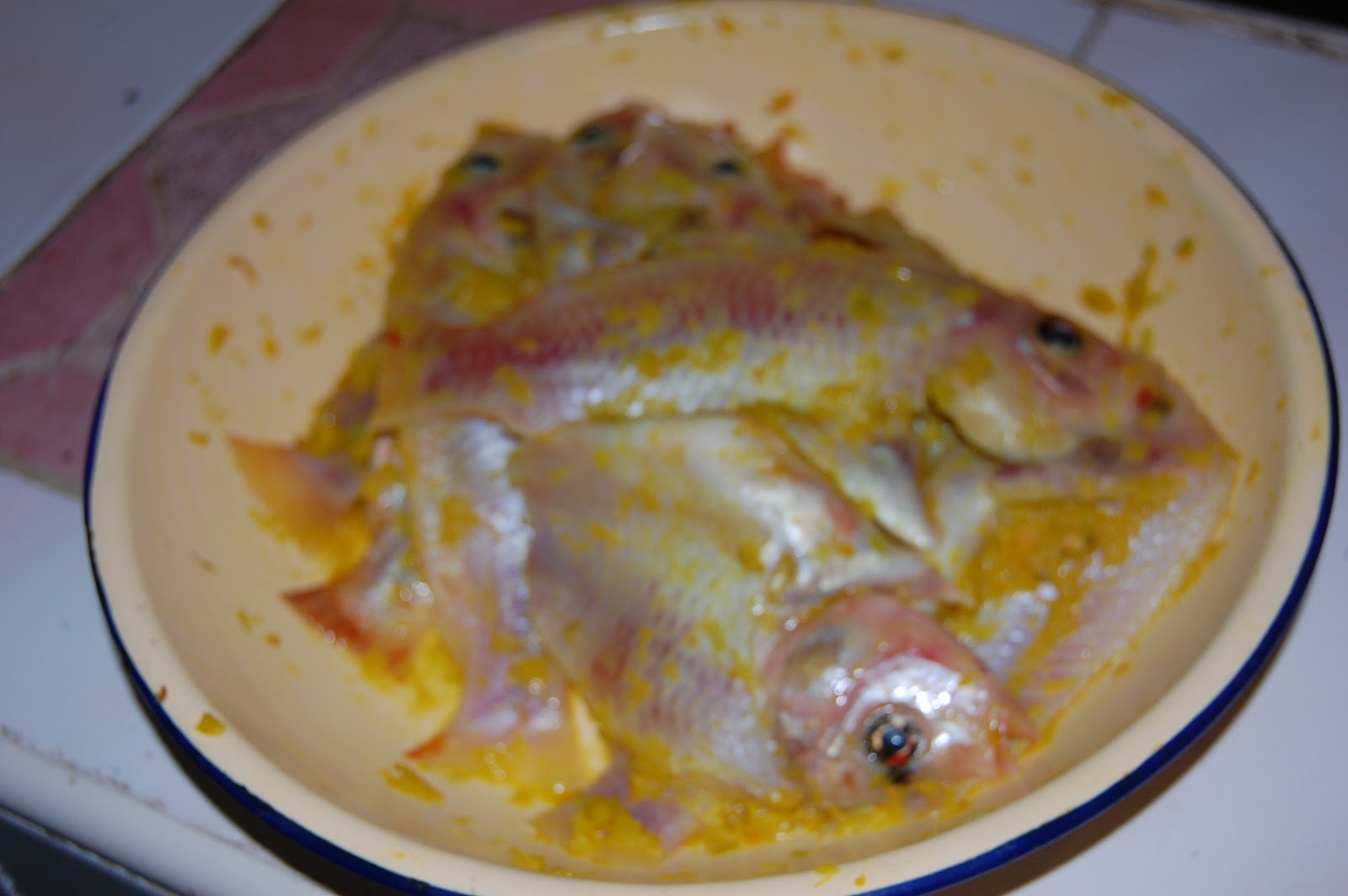
I prefer using a mortar pestle (lesung batu) as opposed to a blender so I placed all the ingredients for the marinate together and pounded them until they became a paste.  I then added some salt and the juice from the calamansi - I added this after the other ingredients were pounded to prevent it from "jumping out" of the pestle.  To speed up this process, I had sliced the lemon grass, onion and tumeric.  Try to use fresh tumeric as it does make a difference to the taste as opposed to using tumeric powder - this will also add better nutrients to the dish.  There are numerous health benefits from the lemon grass, tumeric and calamansi so this is a healthy way to prepare the fish at no expense to the taste.

The marinate was then applied to the fish and left to marinate for 1 hour.  You can marinate it longer if you wish - I was just hungry hence the 1-hour marinate.
This fish can then be grilled, cooked over charcoal or fried.  For a low-calorie option, you might want to avoid deep-frying the fish.  as a note, there is no need to add any flavor enhancers as by using fresh ingredients that bursts with flavor, your palate will enjoy the experience.  In my hurry to eat the fish, I forgot to take pictures of it done :)

Saturday, 9 February 2013

Toona Sureni - long term plan

It is always amazing what you learn from people who become a part of your life.  In this case, I was introduced to Suren leaves or as people from Kerinci call it: daun suhin or in Malay - daun surian, as a condiment you use in cooking rebung and young bananas as well as other savoury dishes.  It adds a slightly sour taste to the dish.
It's botanical name is toona sureni or known in English as Indonesian Mahogany.  I am not sure if it can be easily found in Malaysia and the ones that I know of have been brought over by people originating from Kerinci where it is widely planted.

It is planted from tiny seeds that was sprinkled over the ground and lightly covered with soil.  When it was about 10cm tall, we started to transplant them to various locations on the farm.  Depending on the location of the plant, some died, some grew faster than the others.  In general, I found that if it was planted in the ground that had a 50% clay composition it would grow slower that in ground that had a lower clay composition but at the same time had at least 30% organic matter.

The tree produces distinctive stems of leaves from the main trunk and grows straight without any branches.  In the 2 years that I have had this tree seeded and planted, the tallest tree is now over 8m tall and the shortest is about 2m tall.   Traditionally, it has been used as natural insect repellent including for mosquitoes.  The natural aroma from the leaves and tree bark repels these insects.  I have noticed that the immediate area surrounding the location of the tree has fewer insects, including mosquitoes and gnats.

The young leaf shoots are red in color which turns into a dark green as it matures.  Before the leave fully stem of leaves fully matures - where there are still leaves that have a red tinge to it - is when it is used as a condiment.  Hence I categorize this tree as a tree that falls into the edible landscape variety.

This tree can grow to 30m tall with a trunk diameter of up to 2m - this of course will take years.  You can say that this will be for the next generation which by then should make this into a valuable tree.  The lumber produced is prized in the production of quality wooden furniture and window frames.   I am looking forward to observing the growth of this tree and what its fruit will look like.  So if you are selecting a tree to add to your landscape, you might want to consider this tree with its multi-uses.