Wednesday, 15 May 2013

Put Away the Aji-No-Moto

Before Aji-No-Moto, the dishes still tasted great and a lot of it is due to the freshness of the ingredients and also the herbs and natural seasonings used.  At the farm and at home, we use the various herbs grown at the farm.  All these herbs have all kinds of well-being benefits without thinking of them as health food but as mere tasty seasonings.  Often at the market, I am asked how do you use them as seasoning so here is a summary of how I have used them:
  1. Kemangi or Lemon Basil
    With the natural lemony aroma and taste, I have used this in:
    •  the creation of salad dressings such as chopped kemangi leaves with olive oil, salt and pepper and if you want a zing to it, add some chopped chillies,
    • coconut-based gravy dishes (masak lemak) that includes seafood and/or fish - just add a few leaves
    • chopped and mixed with olive oil and added to pasta
    • seasoning for a marinate for chicken (baked or fried) and for fish and crustaceans - you can either blend it or pound it with a mortar and pestle with other ingredients
       
  2. Holy Basil or Ruku / Selasih Hitam
    It has a creamy taste with a touch of aniseed.  Some ways are:
    • chicken marinate prepared similar to kemangi leaves
    • in savoury dishes such as Asam Pedas on its own or in combination with Kemangi leaves
    • chopped and mixed with olive oil and added to pasta
  3. Lemon grass or Serai
    With its slightly spicy lemony taste, it complements many dishes and also as a refreshing drink:
    • Condiment/seasoning to many savoury dishes such as Asam Pedas, and coconut-based gravy dishes.
    • In combination with other ingredients to create a marinate for fish, seafood or chicken
    • Seasoning for steaming or boiling seafood such as cockles, clams, shrimps, crabs, etc.
       
  4. Ginger Torch Flower or Bunga Kantan
    • Definitely an important ingredient for Asam Pedas and Laksa
    • Condiment for Nasi Kerabu
    • Chopped and added to olive oil with salt and pepper for a salad dressing
  5. Selasih Putih
    With its slightly creamy taste with a twist, it has a subtle taste.  As such, I think that it can be used in many ways but I have only tried it as:
    • an ingredient as a marinate for chicken and beef
    • a seasoning in coconut-based gravy dishes
       
  6. Curry leaves or Daun Kari
    • An important ingredient in making curries to give it that extra tastiness
    • As a seasoning in creating a spicy fried chicken or ayam goreng berempah.
    • The young leaves can be chopped and added to olive oil oil for a "spicy" salad dressing
  7. Suren leaves or Daun Surian
    • As a seasoning for coconut-based gravy dishes that uses young jackfruit, bamboo shoots or young bananas
    • As a condiment to reduce the bitterness of dishes that use papaya shoots and flowers
       
  8. Tumeric or Kunyit
    • The tumeric leaves is used as a seasoning in spicy dishes of chicken and beef such as rendang
    • Chopped tumeric leaves along with the fresh pounded tumeric root as a marinate for chicken or beef
    • Fresh tumeric root pounded and used in coconut-based gravy vegetable or meat based dishes to create a masak lemak kuning.
       
  9. Ginger or Halia
    • Used as a seasoning in many coconut-based gravy dishes of seafood, chicken or beef
    • As a seasoning in soups
    • Pounded or blended with other herbs to create a marinate for chicken, beef and seafood
    • As a seasoning in rice prorridge
       
  10. Galangal or Lengkuas
    • Used as a seasoning in making rendang
    • Pounded and added to other herbs to create a marinate for chicken and beef
    • Used as a seasoning in coconut-based gravy dishes featuring chicken or beef
       
  11. Coriander or Ketumbar
    This highly fragrant leave gives the extra "oomph"
    • Chopped leaves with olive oil, lemon, salt and pepper for a light salad dressing
    • Chopped and used or its own or added to other herbs with salt to create a marinate for meats like chicken and beef which can then be fried or grilled
    • As a seasoning for rice porridge.
    • As a seasoning for soup dishes.
What I have listed are some suggestions.  You can be as creative as you like once you get to know them, the options are endless.  My adventure is just beginning and I hope to uncover others to add to my recipes list.

Life as a Farmer

There was once a time when I was at the top level in corporate world.  There was once a time when my time was just filled with work commitments.  There was once a time when I was jet-setting all over the place.  There was once a time when I was making the big bucks.  Now I am a simple farmer producing food without the use of chemical pesticides, fertilizers or herbicides.  And guess what, I am happy :).
All my previous experiences have been useful in my current vocation.  To debunk some myths, farming today is not for the faint-hearted, illiterate, no-other option person.  It requires you to have lots of "professional" skills.  Among them are planning, time management, project management, budgeting, accounting, communications, personnel management and marketing.  Apart from that you need knowledge of Physics, Chemistry, Biology, Botany, Mathematics - to name a few.  so, if you think that anyone can do farming, think again.  I have great respect for the successful farmers that I know - they have an abundance of knowledge in a wide-array of areas and not having an MBA does not detract them from success, though quite a few do have MBA.  Surprised?  Don't be, this is the new breed of farmers.

At the top of the list, is commitment as there is no off-days in farming as you are dealing with life forms that need tending daily.  Management of the daily activities is prime or it will result in low yield or low quality produce.  Each item that you plan to produce can be seen as a project on its own with its own timeline, resource requirements, costs, sales and marketing tasks.  There is no such thing as letting nature take its course with minimal effort from the farmer.   

For example, take producing bananas as a project.  To have high quality and high yield, you cannot just plant the plant and let it grow on its own and wait for the plant to fruit - so when someone makes an ignorant statement
like "Bananas should be cheap, you just plant and wait for it to fruit.  You do not have to do much.", they should try it.  You need to maintain the plants, ensuring sufficient water and good quality soil with good nutrients.  Periodic maintanance of the plant, removing old leaves and checking the health of the plant, is a must.  You need to watch out for pests (human and animals) and also for sickness.  All this requires knowledge, resources and management.  A good yield per plant is around 15-20kg.  SHL produces and direct sell its bananas to preserve revenue and reduce money-drain.  What do I mean by money-drain - well if we sell to another party we get RM 1.00 per kg but if we sell direct, we get RM 3.00 per kg albeit there is the additional cost of sales.  However, the net result is better revenue for the farm.  By selling it ourselves, it also gives us the control over the quality of the produce - we practice JIT - just in time - so the bananas are harvested and sold at its prime.

Producing vegetables is also another big continuous project.  Going natural introduces added challenges.  The easy way would be to just use chemical pesticides and herbicides and I can get rid of these pests easily and quickly and produce beautiful-looking vegetable with a lot less effort.  However, in line with my principle that I only sell what I want to eat, this is not an option. This project lends itself to research of alternative ways of keeping pests to a minumum whilst providing necessary nutrients for quality vegetable growth.  While it may be more time-consuming, it is worth the result - fresh, tasty, nutritious vegetables without traces of harmful chemicals.  Some may argue that it is only a trace so what is the big deal.  To this I say, the choice is yours.  There are so many things that takes years of consumption before the effect is seen so I leave it to you.

Time management and prioritization is important.  The big benefit now is that my family is first and I arrange what I need to do around my family and my needs and not the corporate agenda.  It is all about scheduling what I
need to get done at the farm against my priority.  Having good staff is also important so that we can work as a team together, living a life and not living for work.  With all the chores at the farm, I do not need to find a gym - I can get my cardio, weight and strength training as well overall workout at the farm without thinking of it as task I need to do but incorporated into my lifestyle.  I also do not worry about retirement as it is my farm and I can continue to be active and have quality of life without having to think what I want to do after retirement if I was still in the corporate world.  There is stress because of standards that I place on myself and due to unexpected issues arising but it can be managed.

So, the next time that you look down on a farmer, realize that this person has probably the equivalent or more skills that you as an engineer, doctor or any of the other "professionals".  We, the farmers, who produce food for you should be treated with respect :)

Tuesday, 14 May 2013

Water features at Suria Helang Lui

I love water, I love being close to water, I love hearing the sound of water.  With the wonderful, clean, water source, I try to maximize what I can do with it, both from food production, household water use and aesthetic landscaping.  The beauty of it all is since the water is from a continuous flowing water source, the water needs to continuously flow out or my pipes will burst so I have no guilt feelings of using the water in all these ways.  When necessary, all the plants are also watered from this same water inflow hence continuing the no chemicals concept on the food production.  My suggestion to those of you who are looking for a place for a retreat, always check the water source options.
At the farm, the water is used for household use including as a drinking water source.  For years now, I have been drinking it direct.  I feel no guilt in taking long, cool showers as the water has to continue to flow out.

One of the main farm activities is to produce tasty fish and the water plays an important role.  The water continuously flow in and out of the ponds, keeping the ponds clean and providing good quality water for the fish to grow and breed.  The pond itself was created based on an old stream which still has a pretty shallow water table.  This also serves as a flood prevention pond as this area has been known to flood albeit not very often.
I spend a substantial amount of time at the farm and I have a home there, my getaway from the busy, hectic Kuala Lumpur, and it is less than an hour
away.  To this end, I like to add features that would further provide for a peaceful and relaxing environment.  It took a couple of years but I finally have my landscape fish pond by the front entrance of the house with a mini waterfall as the water outlet.  There is a lot of river stones all over the property which as we work the land, we have "collected" and this pond features the use of these stones.  The sound of the water flowing into the fish pond is relaxing to hear and makes the area as a great place to have my breakfast, a wonderful way to start the day. 
Another water landscape feature is planned and this one is by the patio of my bedroom.  InsyAllah, this will be ready this year as will the house.

Wednesday, 8 May 2013

Curry tree (Pokok Kari)

No curry dish is complete without the addition of the leaves from the curry tree (Botanical name : Murraya koenegii ).  This tree is very easy to take care of and the growth can be controlled by frequent pruning.  The pruning also encourages it to form branches hence you can shape this tree.  In the late afternoon, as I walk by it, I always get a whiff of curry.
This tree can grow in sunny to partial shade areas.  Until recently, I didn't realize that it could produce beautiful white flowers.  The more mature the leaf is, the stronger the flavor of "curry" it has.
Whilst it is most often used as a "spice" for curry dishes, the young shoots are also eaten raw as ulam. 
Some of the therapeutic benefits reported are :
  • Helps to relieve the pain caused by kidney stones. They also cleanse the urinary tract, preventing bacterial infections.
  • The leaf has tonic properties. It can be mixed with honey or buttermilk to create an herbal drink to strengthen the digestive system. It can also help treat dysentery and diarrhea.
  • It can be applied externally on the skin as treatment for minor skin infections and eruptions.
  • The juice of curry leaves can be used as treatment for eye disorders and to prevent cataracts.
  • The root and bark of the curry plant have medicinal properties. In traditional medicine, the leaves are ground into powder and used to treat diabetes.
  • The fruit of the curry plant is also edible. It can be used for the effective relief and treatment of poisonous stings and bites.
As this tree is easy to grow and produces lots of leaves, you only need to plant one tree in your garden and with it leaves and white flowers, can be a beautiful and edible addition to your landscape.

Tuesday, 12 March 2013

Eggplants - So many varieties

Before I became a farmer, I was vaguely aware of the a couple varieties of the eggplant.  Now, I find that there are so many varieties and called a few names - eggplant, brinjals, aubergine and guinea squash - and is from the plant family Solanaceae.  As with the varied names, there are also many sizes, shapes and colors.  This plant is a perennial but is often cultivated as an annual in locations which have a climate other than tropical.
This plant is propagated from seeds.The plant can grow quite tall but can be controlled by selective pruning to help shape it.  It produces small purple or white flowers with a yellow stamen.  A healthy plant can produce lots of flowers, beautiful to look at so you might want to consider this for your home garden, both as a landscape feature and food source.  At the farm, it is watered regularly and fornightly organic fertilizing and this seems to result in good quality and quantity of flowers and fruit.  I also water them at least once a week with water from the fish pond so that it can receive the various minerals and nutrients available from this water.  Be careful with terung pipit though as it does have sharp thorns on its branches and stems.

It is difficult to spot the difference between the leaves so I wait until the plant produces the fruit although I can distinguish a couple of the varieties.  The fruits produce can weigh the plant stems down so it is important to stake them to prevent the plant from toppling or the fruits from laying on the gound which can damage it.  At the farm, I use a 1" pvc pipe of at least 1m long and then I thread "rafia" string along the branches to provide support.  I find that by threading the string, it prevents damage being done to the branches and provides balanced support.

Some varieties taste better than others eaten raw.  Other ways for preparing it include using it in curries, baked either with olive oil or with a cheese topping, dipped in batter and fried, sauteed with a seasoning of your choice, stuffed with cheese, seafood, breadcrumb mixture or whatever you fancy - the options are limited to your culinary imagination.  A special quality of terung pipit is it is often used locally is as a condiment to reduce the bitterness of papaya shoots.

There are probably more varieties so I look forward to more discoveries....

Tuesday, 5 March 2013

SHL Red Tilapia Asam Pedas


My latest culinary adventure in the SHL Kitchen was to create my own version of the local dish Asam Pedas.  The aim was to use as many ingredients as possible from the farm.  The fish used is fresh red tilapia and with its firmly soft (is that an oxymoron? I guess most of you know what I mean) and ability to absorb flavors, I thought it would be a good fish to use for this dish.  Next I had some bottle gourd which I felt would also be a great vegetable to add to this dish as it can absorb the flavors of the Asam Pedas.  I also used vine-ripened tomatoes to have that slight sweet taste and a touch of sourness.The herbs used in this dish was also available at the farm so the journey began.  The ingredients used were:
  1. Cleaned red tilapia (300gm fish size to make serving much easier
  2. Tamarind juice - add more if you like it really sour and less it you just want to have a subtle taste
  3. Red chillies
  4. Bottle gourd
  5. Vine-ripened tomatoes
  6. Shrimp paste (belacan)
  7. Persicaria odorata or known in English as Vietnamese mint or in Malay as Daun Kesom 
  8. Lemon grass or serai
  9. Red onion
  10. Salt to taste
I do not like to use the blender and prefer to use a mortar and pestle (lesung batu) to create a paste of chillies, belacan and tomatoes.  I also use it to pound the lemon grass to be added.  I brown the sliced red onions in oil and add the chilli-tomato-belacan paste to it.  After a few minutes, allowing the flavors to blend nicely, I added the tamarind juice, lemon grass, daun kesom and additional water to create a gravy.  After it is brought to a boil, the pieces of bottle gourd is added.  When this has become soft and the gravy brought to a boil, the fish is added.  Once the fish is cooked, it is now ready to serve.  It is an easy and quick dish to prepare, all in all taking less than 30 minutes to prepare from cleaning the fish to serving.

SHL Smoked Red Tilapia

One of the things I enjoy is to experiment with ways if preparing whatever we produce.  I began producing smoked red tilapia in November 2012 - in small quantities first to have people try it out.  Based on the positive feedback, I began to make them quite regularly and sell it at the Sunday morning market in Sg. Penchala.  It is a popular item and finishes fast.  Many have asked how it is made so here's how I process it so maybe whoever is interested can try to make it too.
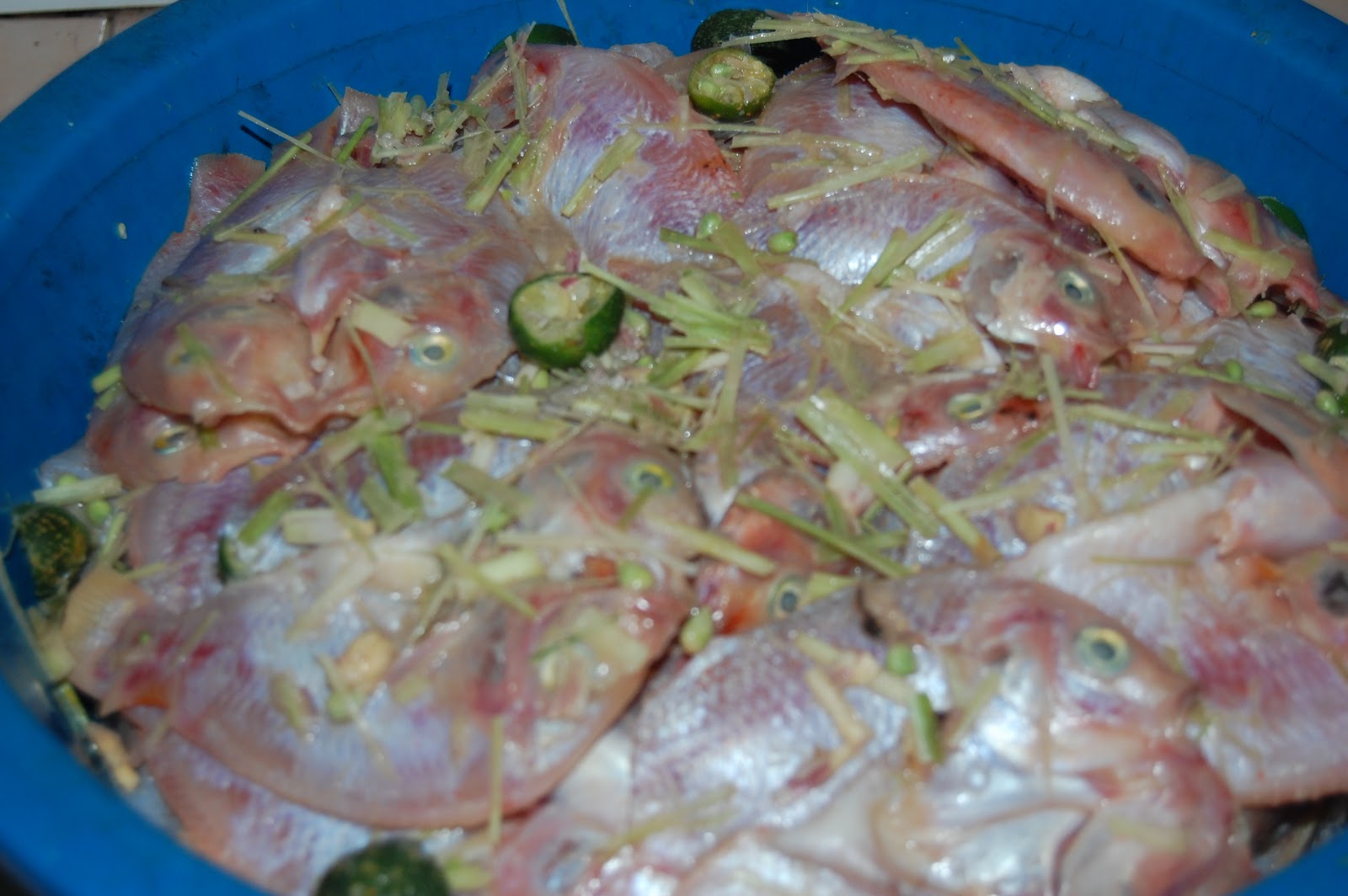
Starting with fresh red tilapia, preferably those bred in running water ponds (as it tastes tons better), clean off the scales and cut it open from the "back" so that is splits open and remains joined by the "tummy" side.  This will enable the fish to absorb more of the marinate and "dries" faster.  Rinse it well and at the farm, since we have clean, river water, the fish doesn't get touched by chemicals in our normal water although it may be present in small quantities.  Be sure that the fish is really fresh or the meat of the fish will become "mush".
Nest step is to prepare the marinate.  The ingredients are:
  1. Lemon grass (serai)
  2. Calamansi (limau kasturi)
  3. Coarse salt
Pound the lemon grass and squeeze in the juice of the calamansi and add salt, mixing these ingredients well.  I also add the calamansi fruit that has been "juiced-out" in the marinate.  Add the fish and mix it well with the marinate and let it marinate for at least 6 hours, keeping it in the fridge the whole time.  I tend to marinate it for at least 24 hours.
The most time-consuming part is the smoking of these fishes.  It is important to have damp firewood that will create the smoke as well as turn into embers to provide the necessary heat to slowly dry the fish.  Be sure not to have flames as this will cook the fish too fast and not allow it to smoke nicely or you will end up with grilled fish and not smoked fish.
Now that you have the smoked fish, what do you do with eat.  There are many ways to prepare them for your meal:
  1. Fry them to create a crispy fish and you can munch on the whole fish.
  2. Cook a sambal with chillies and a touch of shrimp paste (belacan) and tamarind juice (air asam jawa) to create a spicy smoked red tilapia dish.
  3. Cook a coconut-based gravy either with or without chillies, with or without belimbing buloh and add the smoked fish to create a creamy dish or  masak lemak as an accompaniment to your rice.
  4. Chop it up and add to your rice porridge.
If any of you have any other ways of turning it into your meal, I would love to hear about it.  Happy trying :)