Monday, 12 September 2011

Syawal September Market

It has now been a year since I started doing Sunday morning market at Sg. Penchala - although I did take Ramadhan off.  Alhamdulillah, there has been progress since the start.  We are getting the rhytmn for our activities and with the house almost done, we can focus more on farm production.  I am often asked what do we take to market and I thought it would be fun to have a pictorial description.  On last Saturday, I took out my camera and started capturing all the items that we were taking to the market.
 
Bunga Kantan or Ginger Torch

A must if you are cooking laksa, the bunga kantan is harvested a day before market to preserve freshness.  To store, I find that it is best to store with about 1 cm of water in the fridge or chiller.


Ulam Raja

The king of the ulam , the Ulam Raja is harvested one day before market and placed in a container filled with enough water to soak about 1cm of the stem.  This keeps it fresh.


Ruku and Selasih


The Ruku (with slightly purple leaves and flowers and Selasih (green with whitish-green flowers) can be eaten as ulam or salad and used as a condiment in dishes using beef, chicken or fish - at least those are the dishes that I have tried.  But then again, you can be creative.


Bunga Betik

The papaya flowers have a slightly bitter taste that can be removed by cooking them with senduduk hutan leaves.  It can also be eaten raw.


Sweet Potato leaves -the reddish/green
version and the all green

The ubi keledek  or sweet potato leaves are a great option for leafy vegetable alternative.  It is harvested two days before market and kept in container with its stem soaked in about 1 cm of water.  It can be cooked in the similar manner that you cook kangkung.


Bayam kampung or
broad-leaf spinach
The green broad-leaf spinach loves rich, organic soil and is harvested the day before market day and kept in a cool, moist environment to retain freshness.


Papaya shoots or pucuk betik

The Papaya shoots or pucuk betik is picked one day before market day.  It can be stored in a chiller for a couple of days but best eat or cooked within a 2 days from harvest.


Cassava shoots or
pucuk ubi kayu
Two types of cassava shoots or pucuk ubi kayu are sold at the market.  One variety is a thinner and sharper shape and the other is a broader shape.  Once harvested the day prior to market, it needs to be kept cool or it will wilt rather quickly.  These shoots emit heat so it is left overnight in the cool air.


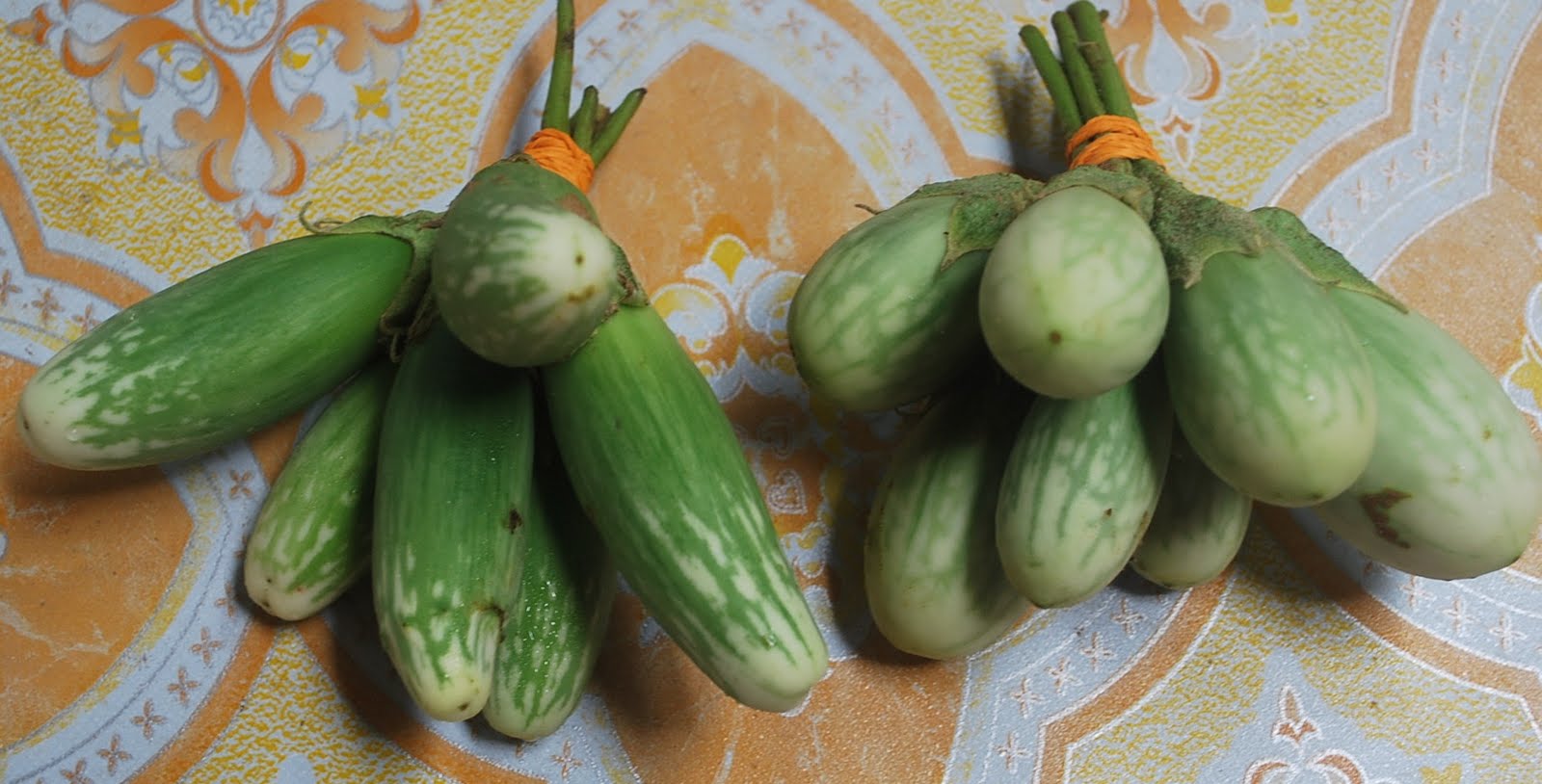
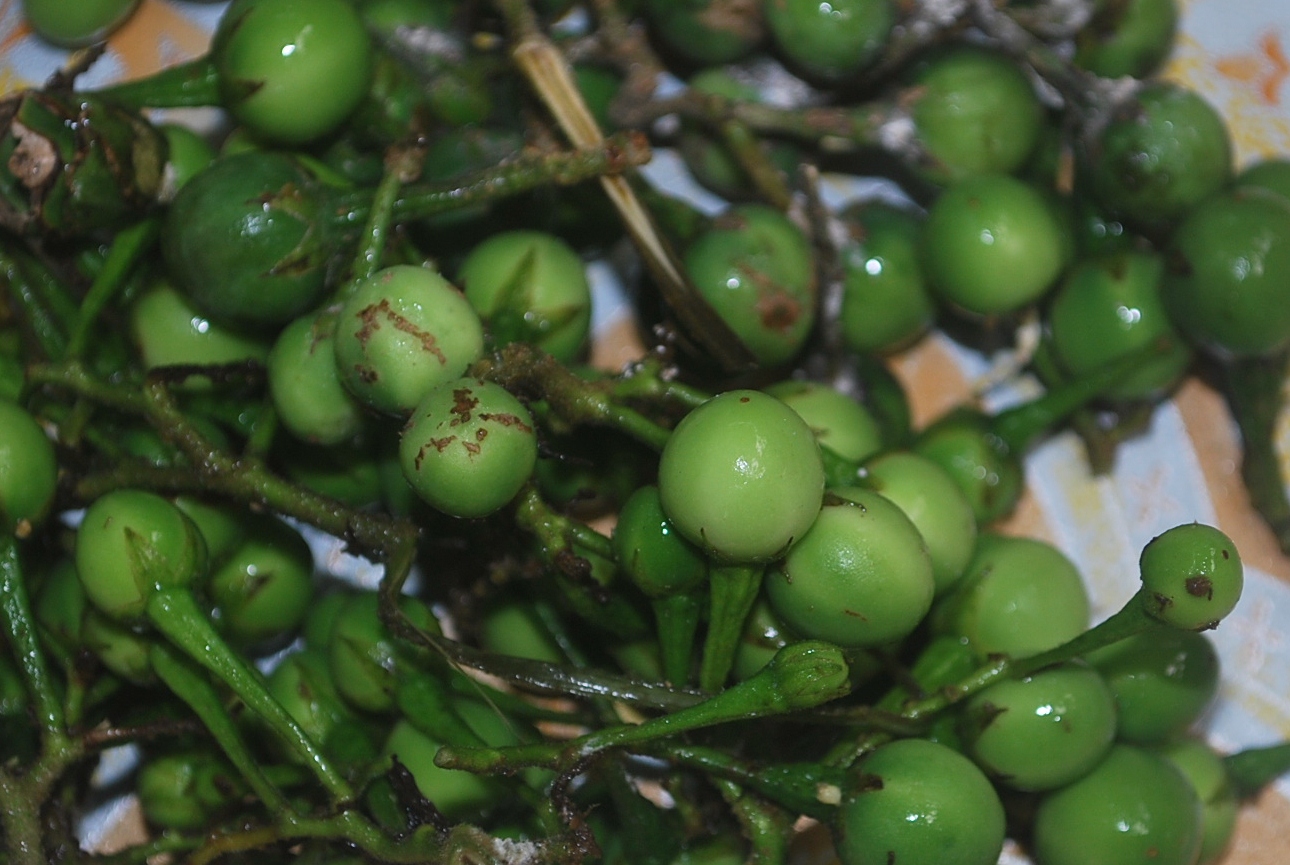
Terong pipit

This variety of aubergine a.k.a. terong pipit is harvested a couple of times of week - Wednesdays and Saturdays - at their prime.  It is kept in the chiller until Sunday market.


Daun salam  shoots

This Indian Basil or daun salam shoots are harvested on Saturday for market.


Terong telunjuk and
terong bulat

This small versions of aubergines, terong telunjuk  and terong bulat, are harvested on Wednesdays and Saturdays, at what I consider to be the tastiest state. 


Belimbing besi


A variety of the starfruit, belimbing besi, is picked as and when they are ready and stored in the chiller for market day.


Tapioca or ubi kayu


Tapioca or ubi kayu, is dug out on a day prior to going to market.  I do not wash the tapioca as this helps retain the freshness of the tuber.


Lemon basil or kemangi

The lemon basil or kemangi do not like water on their leaves for long period of time so it is harvested in the late afternoon the day prior to market  and placed in a container where the bottom of the stems just touch the water.  The leaves bruise easily with continued contact with water so care is exercised to ensure the leaves are kept "dry".


Tumeric leaves or
 daun kunyit

Lemongrass or serai
The tumeric leaves or  daun kunyit as with the other leafy produce is harvested a day prior to market day for freshness.  Whilst the lemon grass or serai is harvested two days prior to market - more because it is time consuming to process it ready for market - and also because it can be kept fresh easily.

Pumpkin or labu
The eggs are collected during the week, jsut after is is laid and is sold weekly.  Similarly with the pumpkin, it is harvested as and when it is ready and stored for market day.


Pisang Kapas

Each week I never know what bananas I will have for market so on Monday or Tuesday, I will make my rounds and check which bananas will ripen by market day.  For "dessert" bananas, when it starts to turn yellow, it is harvested as if it left to fully ripen on the plant, it tends to burst out of its skin.


These are some of the produce we take to market.  As you can imagine, Saturday is the busiest day at the farm and for me as majority of the produce is picked and prepared for market on Sunday.  However, the remaining days are filled with activities of planting, fertilizing, weeding, etc. etc. etc.  I enjoy seeing the progress and it is definitely satisfying when I see people buy and enjoy my produce :)


Wednesday, 7 September 2011

Building a personalized house - Part 1

Amongst the things that I love at the farm is the bounty of nature's beauty.  I also love a lot of light - I think it is a shame when during the day, you would have to turn on the light indoors.  At the same time, since it is at the farm, the house needs to be built functionally, allowing me to carry out my farm activities with ease without having to worry about spending a lot of time organizing and cleaning the house.  I want to be able to spend the majority of my time on farm activities and not housekeeping chores. 
To start with, I made the decision to use tiles for the floor and for the walls as this will make it easy for me to clean.  Here I exercise my uncommon style - I use many different types of tiles and colors to delineate the different areas.  I also use the tiles to create a frame for my treasured pieces such as in my surau.  The tiles are used to frame the two beautiful, Belgian wall hangings that are of great meaning to me - the Al-Fatihah and Ayat Kursi.

I also like lots of fresh air and prefer natural cooling to air-conditioners.  As such, the external walls are topped with lattice to allow for air to circulate with fresh air coming in constantly from the outside, even with all the doors closed. 
In my bedroom, to allow for lots of natural light, I have a door leading to the outdoors, that when completed will have 14 glass panes and two panes will be a swinging "cat's door" to enable my cats to go in and out at will.  The door size is also larger than the standard size at 42in. by 72 in.
On the roof, are skylights and there is a lot of glass tiles on the exterior wall, to further allow light in.  As a result, I do not have to turn on the lights from around 0630 until 1900, contributing to less electricity consumption and being earth-friendly.  I opt to use glass tiles because I didn't want to be bothered with having to install curtains - this way, light comes in but you cannot see inside, only able to see fuzzy shapes.  My bedroom is divided into 4 areas, the solat area, sleeping area, storage area and bathroom.  It has an open concept and I use entryways to define the areas.

I like to have little designs added in to reflect the purpose of the area so the entryway to the solat area has a nice cupola shape and as it has 2 walls to the exteriors, there are clear glass tiles positioned to add more light to the area.  Separating between the sleeping area and the solat area, I love the blue glass tiles, to add a contrast that is cool to the eye.  I also found an interesting wall finisher that is made up of tiny stones that is applied to the wall in the same manner as plaster.  This enabled us to have a nice finish to all those curvy lines in the entryway as well as adding an interesting feature to the entryway.  In keeping with the allowing fresh air to circulate all the time, the top of the wall is finished with lattice-work.

I love having people over and I have an event, insyAllah, that I hold every year, the Durian Fest.  With the aroma of durian and many guests, I needed to have an area that is large enough to house this event.  This is the third area that was built on the farm following the leggo style of building.  The living room is a 24x24 tiled open space from which the areas are attached to and with two double-doors, one the main entrance and the other to what I hope will be a picture-garden when I am done :).  When all the exterior doors are opened, I love the airy feeling.  I have yet to decide if what type of furniture I will place in this room but for the moment, it just houses the tv stand and my bookcases.  

I like leaving this area uncluttered as it connects to the surau so whenever I have solat jemaah, there is a lot of room.  To reduce distractions but yet give a bright and fresh feeling to the surau, the walls are also topped with the lattice-work and although there are no windows, there are clear glass tiles positioned as well as skylights for maximum lighting without making it too warm in the afternoon. 
I have still got quite a lot of work ahead but I am having fun in this adventure.  I can't wait to have it completed because it is a distraction from my main activity, farming.

Edible Landscape - Baby Cucumbers

I was introduced to these cucumbers by one of my staff, Aziz.  It is very popular with people from Kerinci, Sumatera and I later found out that it is also popular with "ulam" afficionados.  Aziz's mother obtained some seeds for me from Kerinci and I decided to experiment with it last year and when I took it to market early this year, it was very popular.  I love seeing the infusion of bright yellow flowers and it appears that my cats enjoy sitting near them in my current planting.

Being busy with the construction at the farm in the last six months, I didn't get to focus much on farming so in last month, I decided it was time to shift more attention to the farm and started planting this cucumber.  It takes about 3-5 days for the seeds to germinate once sown in soil,  It is a climber so I had to prepare a trellis-like structure.  By encouraging it to climb, it will ease the effort during harvesting as well as keeping the cucumbers nice and clean.

I prepared the soil by adding mulch, burnt organic matter and vermicompost as well turning the soil many times to ensure it all mixed well as well as removing unwanted matter.  I enjoyed tracking the progress of this plant as it started to produce more leaves and beautiful yellow flowers, the precursor to the cucumbers.  On alternate days, I will adjust the "arms and legs" of this plant so that it will climb in such a way to ease my efforts when it comes time to pick the cucumbers as well as to create a beautiful arbor in about a months time, creating a lovely addition to the landscape.  The effort was well worth it when in about 2 weeks, the flowers began to blossom.

Three weeks later I noticed that the cucumbers had began to form as well as many flowers were blossoming and more buds forming.  The cucumbers seem to grow at a rather quick rate when in just a few days they increase in size to just about the right size to eat.  I find that it is best to eat them when their skins just smooth-out and about 4 inches or 10-11cm in length.
It is best eaten within 2 days of harvesting and has a nice crisp, sweet taste to it.  I enjoy just munching on them, especially on hot days.  Because of its smaller size, I am never left with half-cut cucumbers in the fridge - as what normally happens with the larger cucumbers.  For salad lovers, I recommend trying this cucumber variety.  These plants lasts about 100 days so I guess in about 2 months time, I will have to start new plants in a different location on the farm, creating a new rotation of the land use at the farm.

Friday, 26 August 2011

Farm Recipes - Papaya Agar-Agar (Jelly)

During Ramadhan, I do not do Sunday morning market.  Instead, I opt to share the produce with family, friends and neighbours.  Among the produce that is ripening in quantity is papaya.  Most often, it is consume raw and as it doesn't last long once it is ripe, and I wanted to consume it in a different manner, I decided to experiment with turning it into a dessert as I thought this would make a refreshing and cooling as well as easy on the stomach dessert after a day of fasting.  So this was my contribution to this week's iftar with my family clan :).
Alternatively, you can also create a refreshing drink by with the papaya puree as a base and adding pineapple, orange or other fruit juices - this will give you a natural vitamin A and C boost as well as great for your digestion.

It is very easy to make this dessert with simple ingredients.  As always, I cook by feel so I can't give you exact measurements just proportions.
Ingredients:
  • Agar-agar
  • Papaya - 1 medium ripe fruit - best if it is tree-ripened
  • Water ( 1 pack of agar-agar to approximately 1 litre of water - adjust the water for softer or harder agar-agar)
  • Sugar
Method:
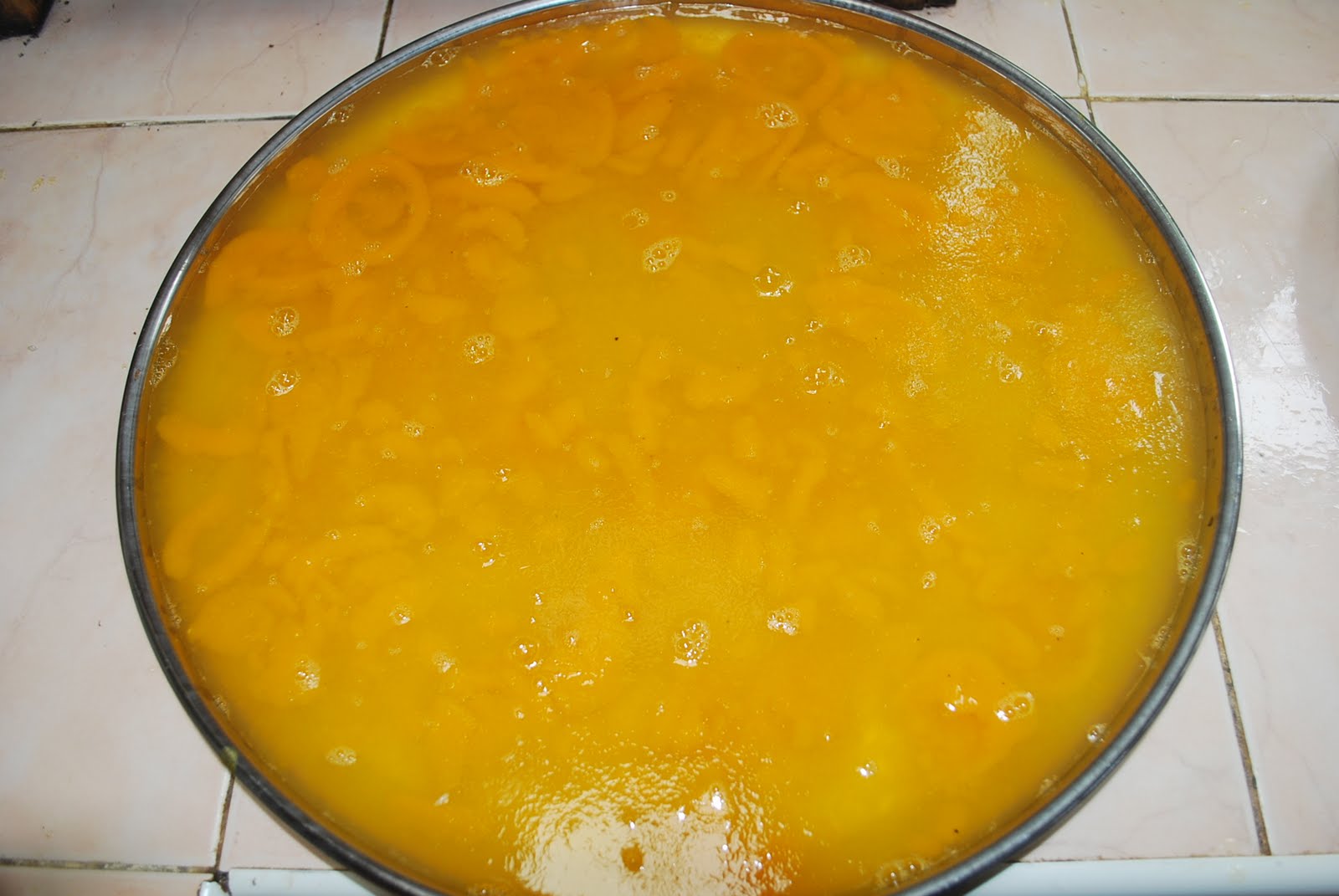
Dissolve the agar-agar in a pot of hot water.  Add sugar according to your taste.  Puree ripe papaya and add a few tablespoons of the puree into the cooking agar-agar until you get a nice color to the mixture.  Place in pans and spoon in the remaining papaya puree into the pan.  Here you can be as creative as you want - creating lines or drops - whatever pattern you desire.  Leave to cool and chill before serving.

Thursday, 21 July 2011

Farm Recipes - Lempok Durian Bread Pudding

After the Durian Fest, I was left with about 20 durians which either needed to be eaten within one day or processed to a form for future consumption.  Since the durians were really creamy and sweet and since I am not a fan of tempoyak, I decided to cook them and turn them into lempok durian.  The process is simple but definitely time consuming. 
My version of lempok was just to cook the flesh until it turned from creamy yellow to caramel in color with a rather thick consistency, similar to dodol.  It takes over an hour and needs to be frequently stirred or it will burn.  One thing for sure, both my arms got a good workout as the durian will become thicker and thicker, requiring more and more effort to stir it.  Once done, after cooling it, I packed them into plastic bags and placed them in the chiller for storage.
Now that I have got this great lempok durian kampong, I decided to experiment.  Most of us have eaten bread puddings with raisins or similar so I decided to experiment with making lempok durian bread pudding. 
This is definitely one of the easiest recipes for me.  What matters is the quality of the ingredients.
Ingredients:
  • Sliced bread
  • Lempok durian
  • Fresh coconut milk
  • Water
Method:
Dissolve the lempok durian in coconut milk and water over medium heat.  Stir constantly to ensure smooth mixture.  I use equal parts of water and coconut milk.
Lightly oil a pan.  Tear the slices of bread into pieces and start layering the pan, alternating between bread and lempok mixture.

Heat over to 180F and bake for 45 minutes.
Can be served warm or room temperature and with misai kucing tea - tastes great!

Notes:
Due to the sweetness of the durian, no sugar was needed for the lempok or in making the pudding.

Happy trying and hope you like it :)

Tuesday, 28 June 2011

SHL Journal - Benefits of Farming

Being able to pursue a dream is great but it becomes wonderful when you get to enjoy all other kinds of benefits.  For starters, since I have started farming, I am able to enjoy fresh, quality food such as fruits, vegetables and fish.  As such, my diet has changed substantially which has contributed to being more healthy and weight loss. 
With the food being great tasting, I either eat them raw of lightly cooked with minimal oil and shorter cooking time.  The result, my meals are lower in calories and richer in vitamins - without me having to resort to counting calories and worrying about what I eat.  I am constantly amazed at all the edible vegetation available in Malaysia and how much information on it is unknown.  We are more aware of fast-foods and convenience foods.  It is shame if we lose the knowledge.
Being very hands-on and being a "laborer" on the farm, I get a very good regular workout without having to go to a specific place and wearing special clothing.  What works best is old, comfortable, loose clothing so how is that for low-cost workout.  At the same time, I get to enjoy fresh air, beautiful surrounding and I do not get bored.  There is a variety of activities that I can choose from that can be classified as aerobic or anaerobic, strength training, cross-training and all those wonderful terms you hear at gyms.  Because I am doing something that I enjoy, each "workout" can last for hours without me checking the time to see if I have worked-out sufficiently.  I continue to be motivated to "work-out" as I get to enjoy the fruits of my labor and also have enjoyed over 10kg in weight loss and toned-up my body, feeling better every day.
While I get physical benefits, I also get mental benefits.  I am continuously learning - from engineering to construction to agriculture to business to health.  I get to exercise the creative side of me with various designs from how the farm should be developed, the house, furniture, and business.  I acquire knowledge on safety including on handling tools and machinery.  There is an enormous opportunity for increasing knowledge so boredom is the last thing on the list.  I enjoy being able to continue learning and my brain gets the exercise it needs.  My home library now consists on books covering all these various topics.  I guess I should figure where these books can be donated someday.
By taking the produce direct from farm and selling it directly, I get the opportunity to interact with people from all social levels.  This provides me with the opportunity to socialize and share information while being able to indulge in my love for studying people and culture.  I learn a lot from these encounters, from how I should communicate to the negatives of stereotyping. I also gain more knowledge on "real people, real lives".
On top of all these, it has also provided me with the opportunity to embark on a spiritual journey, marvelling at all of Allah's creations and his bounty.  I feel blessed.  SubhanAllah.

Thursday, 16 June 2011

SHL Journal - Producing Tasty Fresh Water Fish

Prior to having my own farm, I had tried eating "farmed" fresh water fish and found it to have a "muddy" flavor as well as having a strong odor.  The not-so-nice odor starts emitting from the minute you clean the stomach area of the fish.  Since then, I have avoided eating fresh water fish - one could say that I developed an aversion to it.  I keep hearing some people raving about them so when I started the farm, I decided to research on the possible reasons as to why some fish taste so bad and why some are said to taste good.
From my research, I concluded a few factors.  The first factor is the quality of the water which is dependent on the water source as well as the type and size of the fish pond.  In creating my fish pond, I decided make the pond as natural as possible.  After studying the contour and history of the land, I found that there used to be streams on this property so I decided to use the "stream tracks" as the basis and deepen them to about 1.5-2m depth, creating different depths in different areas of the pond thus having different water height levels.  After all, when you think about it, the river beds are not all one level but have "hills and valleys".  As the pond was dug out, it hit the water table level so thus ensuring (to a certain point) that the pond will not go dry and in a certain way, enable constant supply of ground water to the pond.  The result is a fish pond that resembled a river flowing through the land - definitely not a rectangular or square shape, which is the home to several types of fish - kelah, tilapia merah and bunga, jelawat, ketutu, keli, tongsan, lampam jawa and kerai, puyu, tengas daun and other types of river fish.
Next was to ensure good, clean, fresh water was constantly flowing into the pond and this was achieved by laying polypipe at the source of water up in the hills and piping them down, which coincidentally also supplies the house, with this quality water.  The pond then served as a dual purpose, one to raise fish and the second as a non-stop overflow to the water supply.  By creating the pond this way, I did not have a need for an oxygenation machine that you will find in stagnant water fish ponds.  Without cement base, this enabled the natural-growing plants and algae to flourish with earth-based "food" readily available for them, which also provided another food source to my fishes.  The fish pond would then provide not only a good home for the fishes but also add a beautiful landscape feature to the farm where one can sit by the pond and enjoy the mornings or evenings without that awful water smell of stagnant water (which at times, as with stagnant water, provide a good breeding ground for mosquitoes!).  I learnt from the Department of Natural Resource that they tested the quality of the water by placing kelah fish and if they survived, the water is good.  Ikan kelah  is a fish which will only live in good quality water.  I am happy to see that my kelah is flourishing.
The second factor, is the food for the fish.  Some fish farms feed their fish with carcasses from goats to pigs as well as innards from chicken and also serve as their sewer tank (so no wonder some have an awful smell).  These methods provide for cheaper fish production as well as an easy way out for waste.  I am sure that many of you have heard the saying "You are what you eat".  Well, the same applies to the fish.  How can you expect tasty fish when they consume "garbage"?  Yes, you can produce cheap fish which enables the consumer to then purchase them cheap but I for one, would argue that you can produce reasonable-priced fish without resorting to these alternative food for the fish.  Many take it for granted that the fish they eat is "good" and do not question how it is produced.  After all, if it is bought at the supermarkets and markets, it must be alright.  Think again, the name of the game is price - they want cheap source, mark it up to what the market will bear, and sell it.  Few if any, really check what the fish is fed.  It is also the consumers fault, when they find quality fish which is slightly higher, they complain and want cheaper prices without thought that cheap also means that some corners will be cut and you get what you paid for.  I experimented with feeding the fish a mixture of chopped cassava leaves, "keladi" leaves and inner portion of the banana stem supplemented with fish feed pellets.  The fish also have a selection of small river fish and shrimps that enter the pond from the water supply - a truly natural food source.  I must admit that this approach of feeding the fish requires additional time and effort but it is well worth it.  By creating the food mixture, I also have another option for recycling the banana stems when I harvest the bananas, tapioca and ubi keladi, apart from composting them to be a fertilizer for my "garden".
After one year, the I am now able to start harvesting the fish.  However, with the design of the pond, I am now pondering on the best mechanism to harvest the fish.  I strive to grow the fish as naturally as possible and I have tasted the end result.  I enjoy crispy, fried fish (yes I know, it may not be the healthiest option to cook it) with a dribble of lemon juice that takes as little as 15 minutes from pond to plate.  Now, I love fresh water fish but only the ones from my fish pond with its natural sweetness and no smelly odor or muddy taste - you can say that I am very selective but I want the best in life for me :)