Thursday, 17 July 2014

Joys of Hulu Langat Durian Season

It is that time of the year again - the Durian Season of Hulu Langat.  I am very partial to these "original durians", those that have not been genetically modified or subjected to hormones and such. To me, part of the joy of eating these durians is the discovery of what the fruit is like and the great
taste.  No matter how much we tamper with nature, I feel that what nature produces surpasses our intervention.  I do not get bored eating them.

We have brought the durians to market at the Sg. Penchala Pasar Ramadhan this season and I am happy that we have a good response to our fruits.  One of the questions that I was asked that I thought was interesting was: "Do you pick them from the tree when they are mature?".  We do not pick them from the tree, we wait for them to fall off the tree.  The best time to eat them is the day after it fell off the tree.  We do not inject the trees to encourage fruiting either.  I find it interesting that some people shake the durian in order to select the durian - apparently this is done when buying GM durians to see if the fruit have lots of flesh or more empty space.  Original durians tend to be packed int he fruit so they do not move around in their "cocoon".  The Hulu Langat durian season last for about 1 month and the best fruits are obtained from the second week, somehow the tree gets rid of the "not so good" fruits in the first few days.

Our durians do not have names like D24, C101 or the like - these are from GM durian trees.  Our durians have names like durian kunyit, tembaga, telor buaya and api.  The size and shape of the fruits are not the same from the same tree.  The fruit taste varies from tree to tree, from sweet and creamy to sweet with a bite to it, and the flesh colour from creamy white to orange-yellow.  It is an adventure.

With the abundance with durians, what do you do with them apart from eating them fresh?  There are many options.  You can make lempok durian, lemang durian, kuah durian, dodol durian, durian ice cream and durian cream which you can use as a filling for crepes.  These are the sweet dishes.  For savoury dishes, you can make tempoyak, which essentially is "fermented" durian that is used in gulai tempoyak and also sambal tempoyak.

For making tempoyak, you can use durians that are a few days old and those that have naturally "split" open.  Just remove the flesh from the seeds and place them in a container and place in the refrigerator for a few days before you start using them to make your savoury dishes.  It can keep for a couple of months.

If you find a particular fruit that you love the flavour but just cannot eat them all, just remove the flesh with or without the seed and place them in the freezer.  It can last for months and you can just remove it from the freezer and allow it to defrost before eating them.  So, let us enjoy this wondrous fruit during this season :)

Sunday, 18 May 2014

SHL Herbs - Joys of Misai Kucing and Kemangi

Over the last several years, I have regularly consumed teas which we produce at the farm.  Whilst I have the fresh produce readily available to make infusions, I needed a mechanism so that I can have it easily stored and readily available hence the move to produce teas.  We have several plants and herbs that traditionally have been consumed as tea.  Topping my list is the Misai Kucing tea or infusion.  In alternative therapy, this tea has been used for diabetes, high blood pressure, gout, kidney, rheumatoid athritis and blood cleansing to name a few.

I love food, and have a sweet tooth so this means that I enjoy having rich desserts, Malaysian traditional kuih, and a good steak.  As a preventive measure, I will have a mug of warm Misai Kucing tea as an after meal drink to help regulate my blood sugar and cleanse my system.  On days, when I have had a hard day working out at the farm, I will cool off with a nice, cold glass of this tea to help my body get rid of all the acids produced.  In short, I drink this tea as a normal course of my diet and not view it as a "medicine" which almost always brings a negative connotation to mind.

Being part of my normal drinks selection list, I will drink it at least 3 times a week for maintenance and have additional drinks depending on how rich my meal was.  Being fortunate to be able to produce my own tea, I only use the leaves and the flowers with its soft stalks.  All this enables me to produce a flowery tasting tea without the bitterness and I do not mix it with "fillers" but prefer to have the all-natural taste.

There are basically 2 ways to prepare the tea:

  1. Steeping 1 flat teaspoon of tea mixture in just-boiled water for about 5 minutes.  After straining the tea, more hot water can be added as long as the leaves can still produce the golden-brown tea.  
  2. After bringing the water to a boil, add the tea mixture and reduce the heat to allow a gentle simmer for about 5 minutes.  Turn off the heat and allow it to cool to chosen drinking temperature.  I use this method to prepare a concentrate by simmering 10gm of the mixture in 1 litre of water.  I will leave it to cool, strain it and store it in the refrigerator.  This way, when I would like to have some, I will pour some of the concentrate into a mug and add hot water if I want a hot tea or add cold water with or without ice if I want to have it cold.


I most often prepare a concentrate as this enables me to have it handy whenever I want some.  I normally store the concentrate for no more than 1 week.

I also bought a teapot with the strainer in it so that I can prepare the fresh, hot tea without hassle and then just keep adding hot water to it.  I will store it overnight in the fridge and add more very hot water into the teapot the next morning.  I call my Misai Kucing tea as my "Rebalancing Tea".

I have also produce a "flavored" Misai Kucing tea by combining the Misai Kucing with Kemangi (Lemon Basil).  This produces a tea with a hint of citrus.  In traditional therapy, the Kemangi has minerals and elements that are beneficial for the heart as well as rich in nutrients so by adding this to the tea mixture, it boosts
the therapeutic value of the tea.  I also find that Kemangi helps to alleviate bloating as well as water retention.  The method I use for preparing the tea is the same as for the Misai Kucing tea.  It can also be consumed either hot or cold.  For me, this tea is my "Inner Cleansing Tea".

We also produce pure Kemangi which is also prepare and consumed similar to the other tea mixture.  With its purported heart therapeutic value, I call this my "Heart Love Tea".  With its anti-inflammatory properties, I drink this tea when I have over-worked my muscles and joints.  This is my alternative preventive and natural healing for my muscles and joints.

The key principle for these teas is to produce teas that can be incorporated into my daily diet and be treated as normal drinks.  My aim for my health measures is to prevent or to reduce the impact of my eating and life style on my overall health without feeling forced.  I hope others will be inspired to review their approach and will have a new normal. :)

Wednesday, 22 January 2014

Local Salad Mania

We are used to eating the normal "western" salad that comprises of lettuce, tomatoes, etc.  However, locally, our ancestors have been consuming salads as part of their meal only we call them ulam.    Their salad dressing was sambal belacan only theirs didn't include pesticides or growth hormones.  The argument would be whether minute amounts affects us and many would say, it is only a little bit. However, this little bit will accumulate.  So, in my quest to have better quality meals without "having to pawn the house", I began to look at what we have.  Personally, I love salads and it is very suitable here, with our warm climate.
So, what to put in salads:

  1. daun ulam raja - cosmos caudantus
  2. pucuk tujuh bilah - pereskia sacarosa
  3. kobis - cabbage 
  4. bayam - spinach
  5. bunga kantan - ginger torch
  6. kemangi - lemon basil
  7. ruku - ocinum tenuiflorum
These are some ingredients for the salad which should be naturally grown without pesticides or growth hormones.  Slice the cabbage and ginger torch and just tear the spinach.  The combination of these based on traditional medicine is purported to provide therapeutic benefits for diabetes, high blood pressure, blood cleanser, cancer cells, stomach and colon, respiratory system - in short a whole bunch for the whole body.

Now, how about salad dressing.  My version of the salad dressing with a twist it:

  1. Blended mature daun durian belanda - soursop leaves.
  2. Limau kasturi - calamansi juice
  3. Natural honey (if you like a touch of sweetness)
  4. Virgin olive oil
  5. Salt to taste


What does the salad dressing bring to the table? Based on traditional or homeopathic remedies, it is packed with vitamins and minerals, anti-bacteria, heart benefits, cancer prevention - and so much more.

For this salad, all the ingredients are raw and with the exception of olive oil, are all local ingredients.  To make it totally local, you can try virgin coconut oil instead of virgin olive oil.  When you eat it, it is just another dish and much easier to consume than taking pills.  Try making it as part of your regular meal dish and I hope you reap the benefits and have a healthier life.  If you want to read more in detail about each of the salad ingredients, check out my plant specific blog.  Happy 2014!

Wednesday, 4 December 2013

Growing vegetables: It's all in the soil

I continually strive to improve the quality of the vegetables produced at the farm.  The basic principle is "going organic".  What this means to me is that no chemical pesticides or fertilizers are used and the water source is free from "introduced chemicals".  From my experiments, it all starts with good quality seeds and importantly, good quality soil.

I experimented with different types of organic matter mixed with the soil.  As long as it is organic, I am game to try with some exceptions.  I have used goat manure, cow manure, decomposed vegetation as well as commercially produced organic soil mixture.  To me, it is important what you add to the soil in order to have a good produce in the end.

The current round of vegetables that I am planting have at least 50% organic matter in the soil and I find that it works very well.  It keeps the soil moist and  not soggy and allows for good aeration as well as drainage.  For leafy vegetables, I plant them in polybags and keep them in my greenhouse to help reduce attacks by pests.  I will continue to add more organic matter and organic fertilizer as the plants grow with the frequency dependent on the type of vegetable.  I also seed other types of vegetables like baby cucumber, French beans, long green beans, tomatoes and various others with this highly organic soil mixture.  This helps produce healthy "baby plants" before they are transplanted outside with the exception of tomatoes which I keep in the greenhouse.  The main reason why the tomatoes remain in the greenhouse is because the chickens love the ripe tomatoes and would fly up to the fruits and peck at them!

By electing to go organic, I spray my vegetables with serai wangi juice which serves as a deterrent but I do have to do some manual tasks like manually removing the slugs and caterpillars as well as spraying them with water to reduce the "white flies".

I like to eat most of my vegetables raw so keeping it free from chemical pesticides removes the worry of ingesting harmful chemicals.  To me, washing the vegetables may remove most of these chemicals but some will still remain within the vegetable itself as well as on the surface.  The weirdest advise I have ever received was, in order to remove the chemical pesticides, to clean the vegetables with a mixture of water and Clorox!

After I harvest the vegetables, I will "process" the soil by mixing it with more organic matter before re-using it to plant more vegetables.  I love it when I encounter earthworms as these are among soil's natural best friends.

Thursday, 19 September 2013

Tasty dried, lightly salted lampan

I love experimenting with that I can do to the fish we produce at the farm.  Since our water source is from the river upstream, all kinds of river fish enter the pond so when we "process" the pond, we always get surprises.  Previously, I had place some "lampam jawa" which did very well in the pond.  I think the flowing, fresh river water had a lot to do with it along with what we feed them - they love the green stuff.  It appears that some river lampam had also entered into the pond and now I have cross-bred lampam.
Lampam is a fish with many bones - I think of it as the fresh water "terubok".  It has high fat content so from my experiments, I find it almost impossible to have a really bone-dry fish but what will result is the fish oil will come out and leave the fish moist-like. 

This fish can grow to be big, sometime more than 1 kg in less than 1 year.  This time around I opted to use the smaller sized ones (3-4 inches long) to create a "crispier" fish when fried.  At the same time, since the population of the lampam had dramatically increased, this allowed me to reduce the population helping ensure the total fish population in the next round will flourish.
Each fish was cleaned, removing the scales and innards. and rinsed with water.  Since I use clean, river water, no pollutants or chemicals were introduced to the fish.  I added coarse salt to the rinse water for two reasons: to act as a natural cleanser and to have a natural "preservative".  The fish has a subtle salty taste which for some, would mean having to add more salt and for those who prefer to maintain a low-salt diet, they would not need to soak the fish to try and remove the salt.
For me, in ensuring that you produce good quality dried fish, it is important
to have the ability to dry the fish in an environment where it will not be exposed to flies which will lay eggs on the fish and the maggots will eat the fish flesh as it develops - all these in a couple of days.  At the farm, we have constructed a dryer box which enables us to dry the fish and keeping all those pesky flies away.

Once dried, they can be kept for months, longer if kept in a cool and dry location.  We pack them with a dessicant which helps to keep the moisture away.
There are many ways that you can prepare this dried fish.  You can fry it until it is crispy and serve with some lime or calamansi juice squeezed over the too, cook it with a chilli paste and other condiments to create a sambal similar to sambal ikan bilis (anchovies), cooked in a curry, fried with onion rings, and many other ways.  You are only limited by your imagination.

Thursday, 5 September 2013

Key Lime

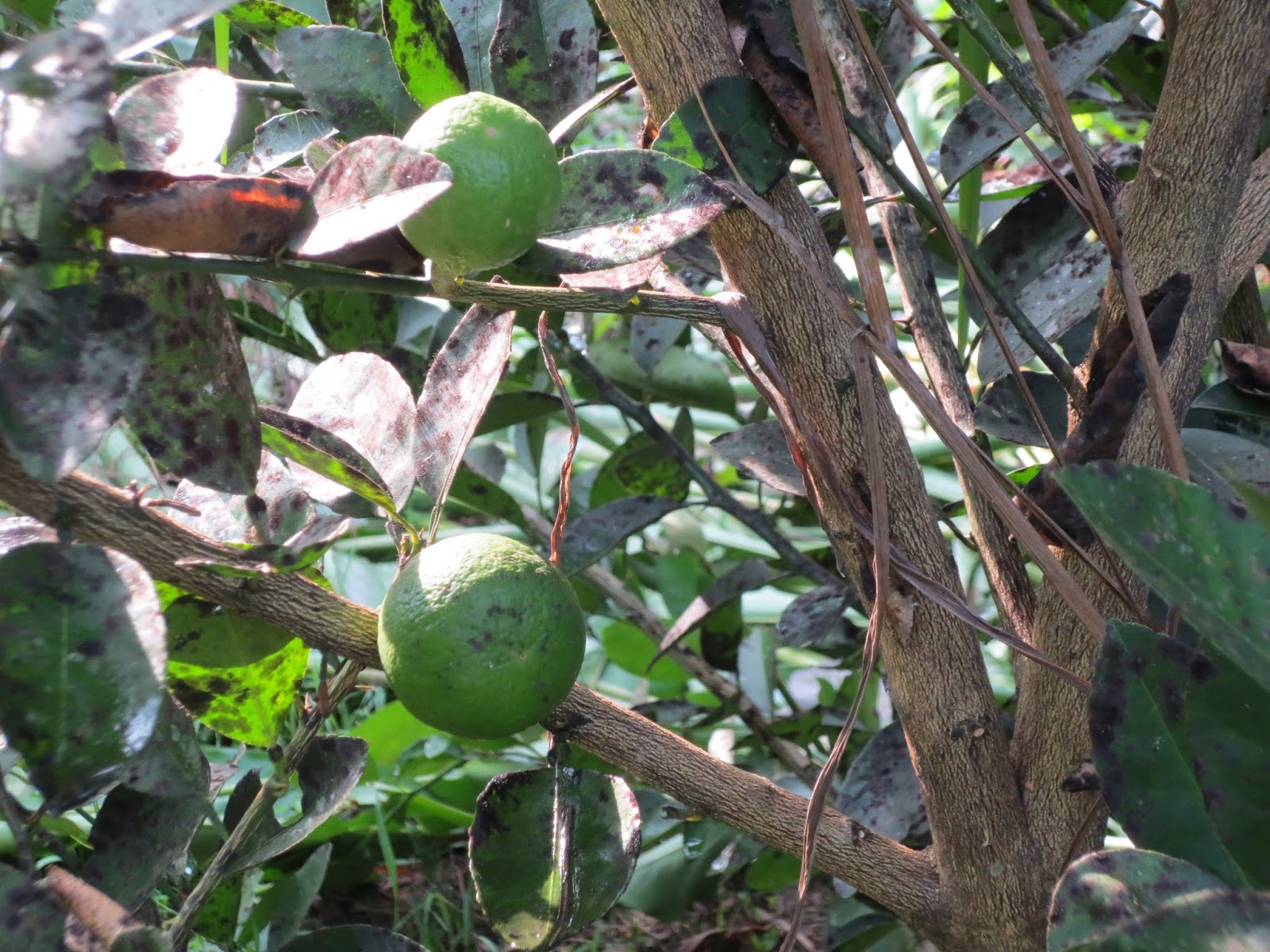
I love citrus fruits either used as a flavoring for dishes or making drinks.  At the farm, we have planted a few varieties including key lime or limau nipis (botanical name: citrus aurantifolia) grows well in tropical climates.  Locally, this fruit is often used to flavor dishes such as laksa, curries and also to make drinks.  Many people are also familiar with key lime pie of which the key ingredient is the key lime.

We planted a few trees and from the baby plants to fruiting, it took about 2 years.  Growing it has been a challenge because there are some pests that just love to eat the leaf shoots, most often the caterpillar.  Every few months, I will prune the tree to encourage growth of new shoots and flowering.  The trees can grow to around 5m tall so by keeping it pruned, I can better control the growth of the tree.  It has thorns on the stems so be careful when you are handling the tree.  Continued maintenance will help ensure that the tree fruits around the year.

The fruit has a tart flavor with a slight bitterness.  It has a relatively high level of vitamin C with traces of iron, calcium and niacin.  The therapeutic value of the juice is purported to be to help detoxify the liver as well as a blood cleanser.  Some have mixed it with honey to help with sore throat and the common cold.  The juice of this fruit is also often used in beauty and hair treatments.  It can be applied to the face as an astringent and to help tighten open facial pores and reduce facial oil.  It is also often used as an ingredient in cleansers.  I have used a mixture of the key lime, including its skin, with water and sprayed it as an odor eliminator leaving a nice citrus fragrance.

Thursday, 18 July 2013

Ramadhan 1434 at SHL

Fasting does not mean that you stop doing what you are doing but I view it as a time to review, prepare, improve and adjust.  An opportunity to "hijrah" to be better.  It has been four years since I first started out on transforming SHL to overgrown "jungle" to a farm and it now does not look anything like what it used to although I have tried to preserve the land contour as much as possible.  I am not so much a lover of totally flat land - to me, it doesn't look natural and you will have gotten rid the rich, beautiful top soil by bull-dozing the land.

Through the years, and many experiments, we have decided to focus on a few vegetables, albeit in favor of what I love.  The chosen ones: cabbage, tomatoes, long green beans, French beans, baby cucumbers, petola, okra, the green mustard family (sawi and the like) and a variety of aubergine (terung).  Also selected are peria and chili.  We also plant tapioca and I am never sure what category to place this in as we do use the young leaf shoots for vegetables and the tuber can be eaten in many ways - both savory and sweet.  The aim is to make the produce available every time we go to market.  Taking the lessons learnt from the soil composition, soil preparation, care and maintenance of them, we are starting a new cycle.  It is a great time for us to do this as we do not do Sunday market during Ramadhan and re-start two weeks after Syawal.  With this time frame, it gives us time to grow and care for them.

A few days before Ramadhan, we completed the back-breaking work of creating planting beds and mixing goat/cow manure into the soil.  It is mainly manual labor as we do not use any herbicide so removal of grass and weeds and turning the soil give a superb workout.  We leave the beds for a week whilst we start seeding and by the time we feel that it is time to plant the beds, the seedlings are ready to be transferred.  It is also a time for us to construct the support for the climbers - reusing materials as much as possible such as the fencing material that have been removed now that we have replaced the boundaries with a wall and zinc fence.
It has also been raining almost daily so this gives the soil a good water supply helping with the decomposition of the manure and spreading of the nutrients.  The planting beds are covered with black plastic material to prevent weeds and to reduce the weeding required around the planted area.

The fruit tree planting is also done - have so we are moving to care and maintenance on the fruit trees. I am happy with the selection that we limau bali, calamansi (limau kasturi), jackfruit (nangka), cempedak, soursop (durian belanda), delima, avocado, dukong, coconut and of course, an extensive variety of bananas.   The list I think is good enough considering the amount of space we have: durian, mangosteen, mango, longan, papaya, rambutan, pulasan, Quite a few of the trees have begun fruiting so we are able to enjoy the "fruits of our labor".

On the herbs and condiments front, there are still some varieties that I would like to plant and I need to make some time for this area.  The tea-making herbs that I am focusing on are misai kucing, lemon basil (kemangi) and ruku.  These are my favorites and I like the therapeutic properties that they have.  The herbal plants selected are based on their traditional uses of Malay homeopathy and its therapeutic values.  For condiments, we have turmeric, galangal (lengkuas), ginger torch (bunga kantan), ginger and lemon grass (serai) - these I consider to be the staple condiments in a lot of dishes that I cook along with the other herbs.

Of course no farm is complete without some animals.  The chicken count is up to 60 now of the ayam kampong variety.  From time to time, I get people who come by who want to buy my chicken but they want to buy the cockerel.  I am always suspicious because when I say I only sell my chicken slaughtered and they say that they prefer to slaughter it themselves.  When I offer the hens, they are not interested.  I know that the kind that I have is what some crazies look for in cock-fighting and this is one activity that I am against.  This Ramadhan we will be selling 20 chickens as part of the activity of breeding and growing them.  We will need to do some repairs and maintenance work on the chicken run which I am planning to start after Ramadhan.We also have fresh water fish but this will be a topic in a future blog. 

All in all, you could say that we are still active in Ramadhan and these activities remind us of the bounty from Allah s.w.t.  To all my Muslim readers, we wish you Selamat menunaikan ibadah di bulan Ramadhan yang mulia ini.